BY PEARCE BANNON The Ottawa Citizen
June 17, 1997
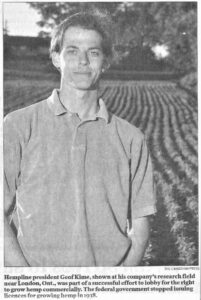
The inspiration for Geof Kime’s drive to become Canada’s first commercial grower of hemp in 60 years is hanging on the wall at his London office.
Everyday the president of Hempline Inc. is greeted by a black-and-white photo of Lambton County farmer Howard Fraleigh, taken back in the 1930s, standing next to his crop of three-metre cannabis stalks. “He was a pioneer that I take great interest in, and in what he was able to do, and I sort of modelled our activities a little bit after his pioneering spirit,” said Mr. Kime.
Mr. Fraleigh employed several people at his farm in the town of Forest, about 100 kilometres northwest of London, where they grew hemp and processed it before the government stopped issuing licences for growing hemp in 1938.
The finished product, hemp fibre, was taken to market and sold. “That’s very much along the lines of what we’re interested in doing in the 1990s”, said Mr. Kime, who with his partner Joe Strobel founded Hempline three years ago. Since then, Hempline has received licensing approval from the federal government to research hemp growing at farms near London and Tillsonburg, about 40 kilometres southeast of London.
Hempline is also researching and designing equipment for the harvesting, drying and baling of hemp, and with help from the Ontario Ministry of Agriculture and Food is studying the potential markets for hemp stalk. Thanks to recent changes to Canada’s drug laws, Hempline plans to grow 1,000 acres of hemp in southwestern Ontario next year to kick off its first year of commercial production. If everything goes according to plan, mature hemp stalks will be processed at Hempline’s London-based fibre separation facility, to be built this fall, with equipment specially designed for the process.
Bill C-8, which came into effect last month, contains provisions scheduled to be in place by early 1998 that will allow for the commercial growing of hemp. Although commercially grown hemp is similar in appearance to marijuana, hemp has lower levels of tetrahydrocannabinol (THC), the psychoactive ingredient that produces its high. In fact, it was partly Mr. Kime’s lobbying effort that ensured commercial growing can start by next year.
Last year, Mr. Kime appeared before the Senate’s legal and constitutional affairs committee, which studied Bill C-8, and asked for an amendment that would exempt mature cannabis stock and its fibres from regulated substance status.
Senator Lorna Milne, who sat on the committee, was impressed by Mr. Kime’s presentation, and by information she received from other agricultural groups. She rallied to his side. “One of the things that most attracted me to the idea of growing hemp was the fact that I see it as a substitute crop on the tobacco lands of southern Ontario.” said Mrs. Milne.
Mrs. Milne said she has written assurance from Health Canada that regulations will be in place by 1998, in time for the planting season. Far from seeing the government as a roadblock, Mr. Kime credits Mrs. Milne and several federal and provincial agencies for giving Canada a “three- to four-year head start over the United States on the commercial growing of hemp”.
“We are going to be in full commercial production long before the Americans will be,” Mr. Kime said. “And I think that’s something the federal government should be proud of and in essence should be recognized”.